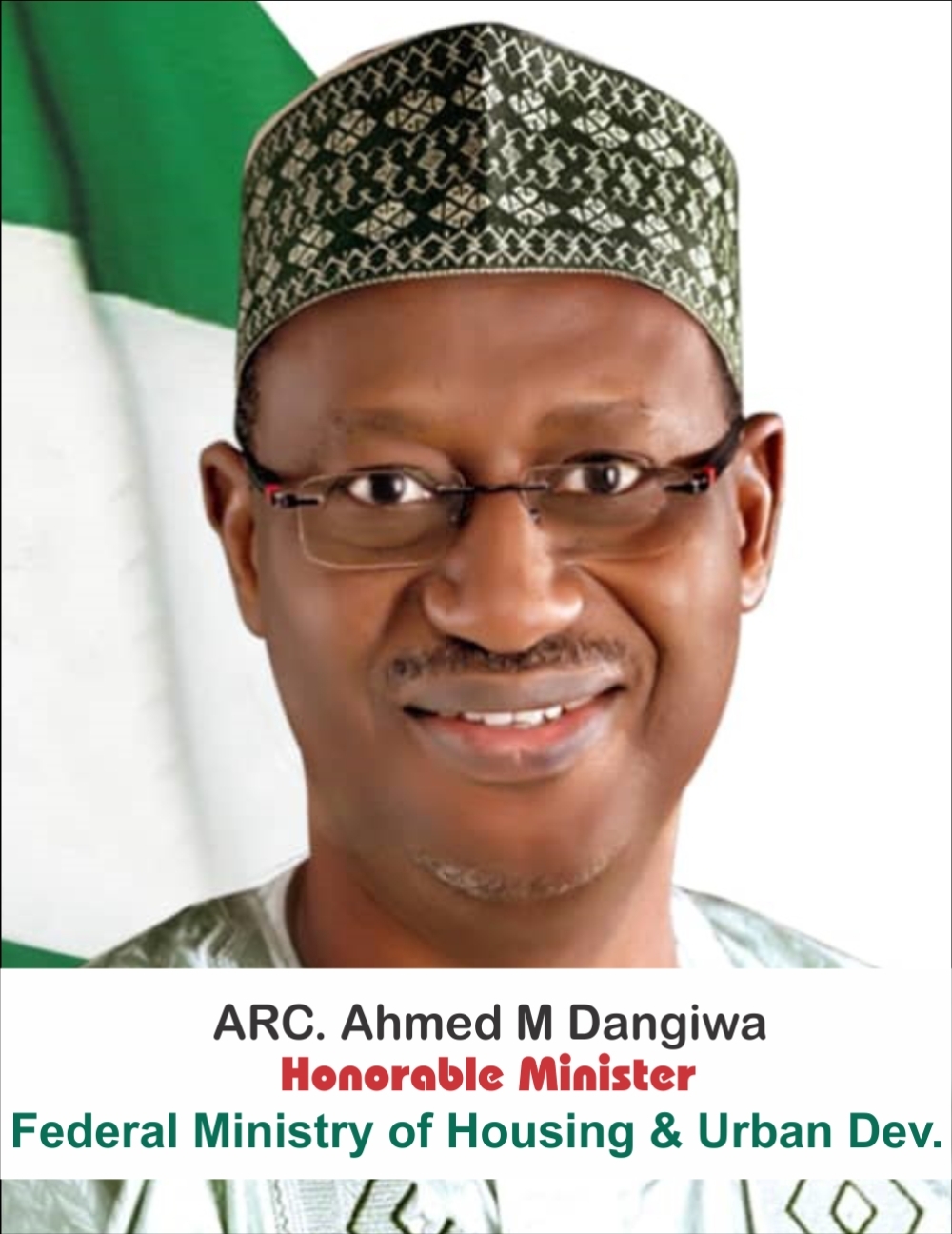
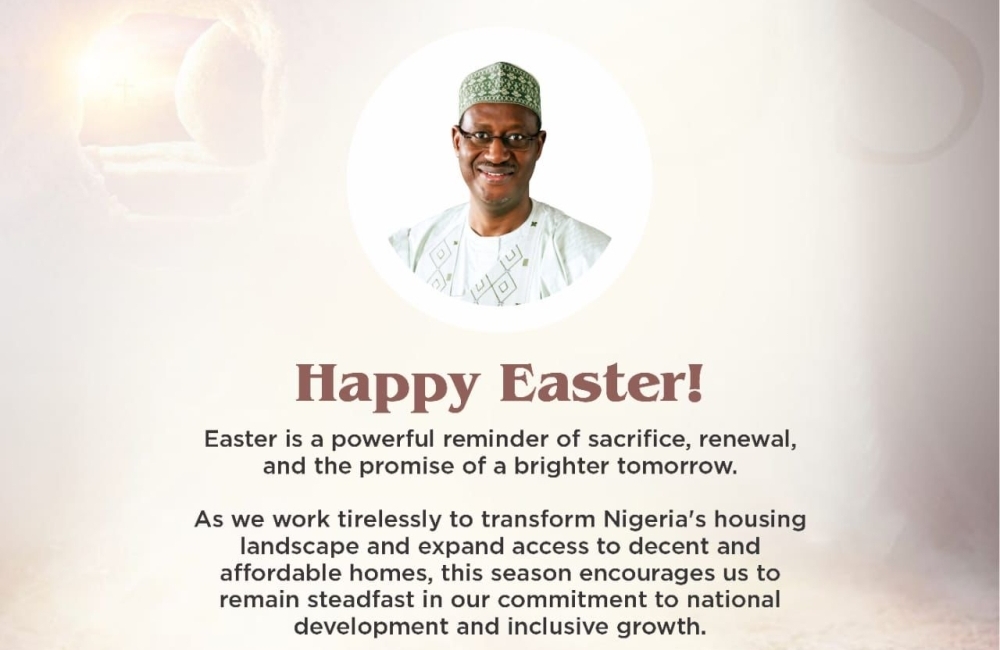
As Christians across Nigeria and around the world celebrate Easter, I extend my warm greetings and best wishes to all our Christian brothers and sisters.
Easter is a season that reminds us of the enduring values of sacrifice, hope, love, and renewal. These values are universal and speak to the shared aspirations of all Nigerians — the desire to build a peaceful, united, and prosperous nation.
As a Muslim, I deeply respect and celebrate with our Christian community at this sacred time. The message of Easter encourages us all to continue working together in unity, compassion, and service to one another.
On behalf of the Federal Ministry of Housing and Urban Development, I wish all Christians a joyful and blessed Easter celebration. May this season renew our collective hope and strengthen our commitment to building a better Nigeria for all.
Happy Easter.
As Christians across Nigeria and around the world celebrate Easter, I extend my warm greetings and best wishes to all our Christian brothers and sisters. As a Muslim, I deeply respect and celebrate with our Christian community at this sacred time. The message of Easter encourages us all to continue working together in unity, compassion, and service to one another. Happy Easter.
Easter is a season that reminds us of the enduring values of sacrifice, hope, love, and renewal. These values are universal and speak to the shared aspirations of all Nigerians — the desire to build a peaceful, united, and prosperous nation.
On behalf of the Federal Ministry of Housing and Urban Development, I wish all Christians a joyful and blessed Easter celebration. May this season renew our collective hope and strengthen our commitment to building a better Nigeria for all.
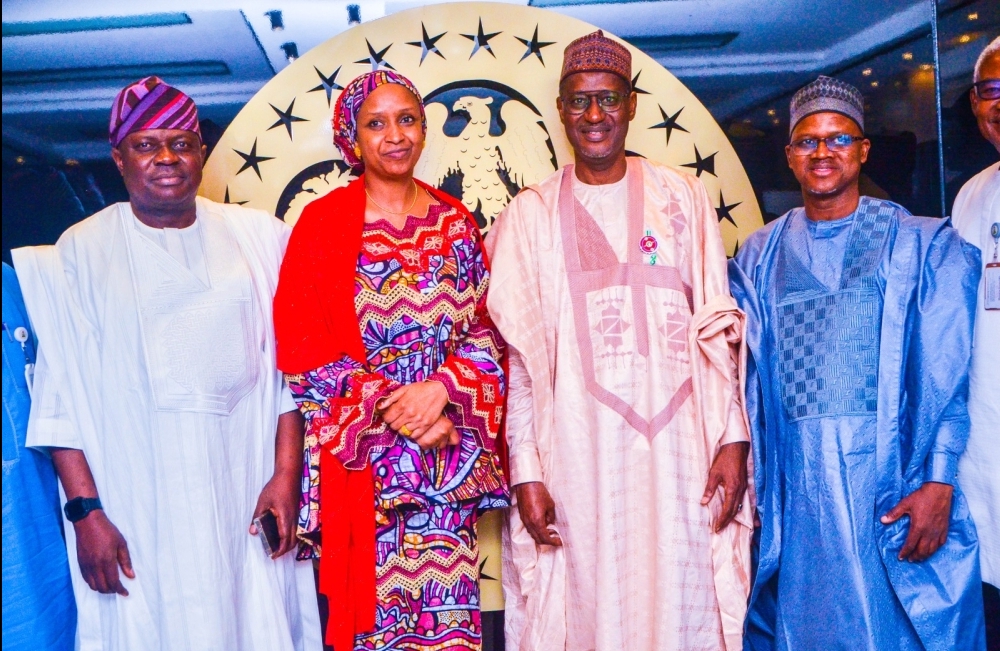
We are on Track to Meeting Annual Target for Housing Delivery - Dangiwa Minister of Housing and Urban Development, Arc. Ahmed Musa Dangiwa has affirmed that the progress so far recorded under the Renewed Hope Cities and Estate programme alongside the housing units delivered by the agencies of the Ministry, Federal Mortgage Bank of Nigeria and Federal Housing Authority, shows that the Ministry is clearly on course to meet close to an annual target of 20000 housing units. Dangiwa made this affirmation during the engagement with the Special Assistant to the President on Policy and Coordination and Head of Central Results Delivery Coordination Unit (CRDCU), Hadiza Bala Usman. The engagement with CRDCU was on the 1st - 3rd Quarters 2024 Performance Assessment Report on Implementation of Presidential Priorities and Ministerial Deliverable of the Ministry of Housing and Urban Development which was presented by Hadiza Bala Usman Dangiwa appreciated the continuous monitoring from the CRDCU team, saying that it has kept the Ministry at an alert and ready to deal with problems. “As your team has already seen from our first, second and third quarter reports, we have been focused and working creatively hard as a Ministry to deliver results and impacts”, he noted. The Minister informed that the Renewed Hope Cities and Estates program currently has 10, 112 housing units ongoing at 14 construction sites nationwide, which includes 3000 housing units in 12 estates at 250 units per state, under the 2023 ₦50bn supplementary budget; and 3,612 units in Karsana Renewed Hope City, aside the 1,500 units in Kano and 2000 units in Lagos State. He disclosed that President Bola Ahmed Tinubu, GCFR, would next week, December 17th and 19th respectively be officiating the groundbreaking of two additional Renewed Hope Cities in Kano and Lagos States, consisting of 2,500 units in Ibeju Lekki Lagos and 1 500 units in Kano, saying that the funding was by the FMBN and a Public Private Partnership (PPP) arrangement. Dangiwa also explained that the Ministry has embraced the PPP arrangement to compliment the insufficiency of funding from the budgetary allocation. Expressing concerns that the housing problems in the nation requires at least 550,000 housing units annually over the next 10 years to close the deficit, the Minister maintained optimism that the Ministry has achieved a significant progress under the Renewed Hope Agenda “The Ministry needs a bigger budgetary allocation for housing units, we have engaged the National Assembly currently and they have expressed willingness to support ₦500bn budget for the Ministry in 2025, we would like the CRDCU to also help us support and push for this course”, he said. Accordingky, he also informed the CRDCU team that the Ministry is seeking to deepen its urban development interventions, citing the assurance of the executive director of the UN-Habitat during a recent executive board meeting in Nairobi, that every money invested in the National Urban Renewal and Slum Upgrade program could leverage 3 folds through their institution partners; In his words, “we need a minimum of ₦50bn annually revolving, to drive a sustainable Slum Upgrade and Urban development which is key to Nigeria meeting the Sustainable Development Goals (SDG’s) 2030”. Similarly. Dangiwa informed that the Ministry's intervention in slums upgrade includes providing basic services like access roads, drainages, water, among others, to make slum areas more livable; “ We currently have over 100 projects nationwide with close to 60 already completed" he said While appreciating the Ministry's significant progress since submission of the Q 3 report, he acknowledged some challenges hindering some efforts at the Ministry to include untimely release of budgetary allocation and high cost of building materials. He further solicited the support of the CRDCU in the area of assuring early release of budgetary allocations; partnerships with the state governments, National Economic Council, the National Assembly and other key stakeholders as well as the review of the Land Use Act. In her remarks and presentation of the Q1-Q3 2024 Performance Assessment Report, the Special Adviser to the President on Policy and Coordination and Head of Central Results Delivery Coordination Unit (CRDCU), Hadiza Bala Usman, emphasized the importance of collaboration and data -driven governance, noting that effective data management is essential for validating progress and enhancing performance. She highlighted the Ministry’s High-Impact Deliverables and Indicators, developed in partnership with the CRDCU, as part of the Performance Bond signed by Ministers in November 2023, mentioning enhancing Infrastructure and Transportation as enablers of growth. Similarly, the Special Adviser listed the housing ministry's deliverables which includes; reviewing the Land Use Act in conjunction with the National Assembly and State Governments, facilitation and construction of at least 20,000 affordable housing units annually, and rehabilitating federal secretariats nationwide to improve government infrastructure. The CRDCU stressed the need for improved data management systems within the ministry, highlighting the critical role of accurate data in tracking project timelines, particularly the recommended one-year gestation period for project completion. CRDCU also recommended that the office of the Minister in conjunction with the permanent secretary take a more coordinated approach to the project management of the inter ministerial deliverables to enable rigorous approach to weekly project tracking and reporting. ...
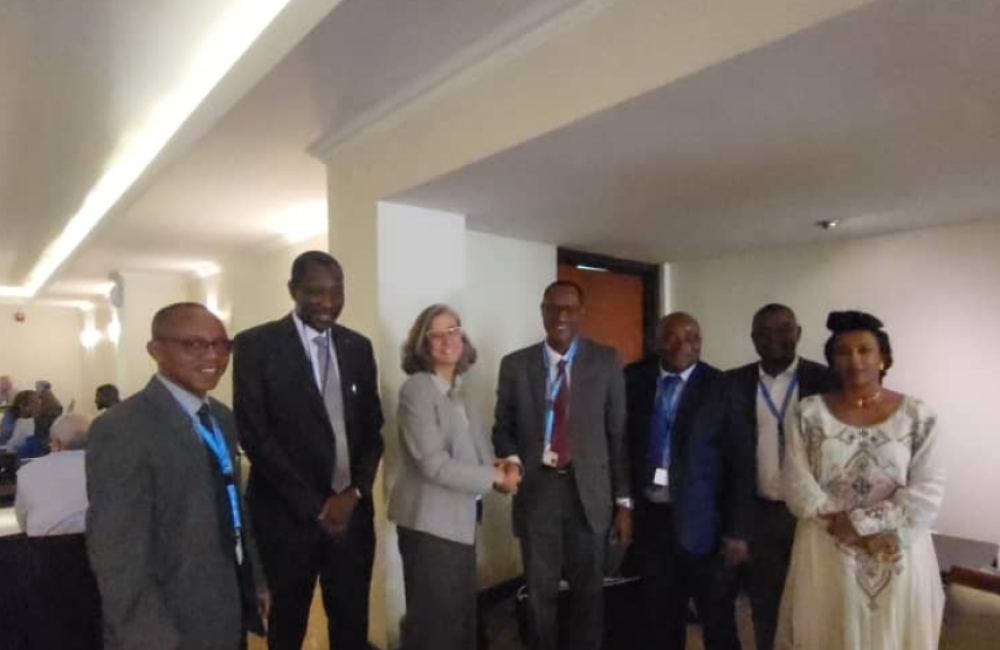
DANGIWA SEEKS INCREASED UN-HABITAT SUPPORT FOR NIGERIA’S NATIONAL URBAN RENEWAL AND SLUM UPGRADE PROGRAMME • Announces Plans for Nigeria’s First National Urban Forum Mid 2025 Nairobi, Kenya – December 5, 2024: In a bid to strengthen Nigeria’s efforts in addressing urban development challenges, the Hon. Minister of Housing and Urban Development, Arc. Ahmed Musa Dangiwa, has called for increased support and collaboration from UN-Habitat. Speaking during a working lunch with the new Executive Director of UN-Habitat, Ms. Anaclaudia Rossbach, on the sidelines of the 2nd Session of the 2024 UN-Habitat Executive Board Meeting in Nairobi, the Minister emphasized the urgency of addressing Nigeria’s housing and urban challenges. Arc. Dangiwa underscored the critical state of housing in Nigeria, noting that over 75% of the country’s 42 million housing units are substandard, with nearly half of the population living in informal settlements. To address these challenges, he highlighted the Federal Government’s National Urban Renewal and Slum Upgrade Programme (NURSUP), which has completed projects at 54 sites nationwide, with 56 additional projects underway. These efforts aim to improve essential infrastructure such as water supply, solar-powered streetlights, access roads, drainage systems, and waste management solutions. The Minister stressed the importance of robust partnerships with international organizations like UN-Habitat to scale up these initiatives. “Our collaboration with UN-Habitat is critical. With your support, we aim to expand and enhance Nigeria’s National Urban Renewal and Slum Upgrade Programme to deliver transformative outcomes for our people,” he stated. As part of Nigeria’s commitment to the global urban agenda, Arc. Dangiwa announced plans to host the country’s first National Urban Forum in June or July 2025. The forum will bring together stakeholders—including government representatives, urban planners, developers, civil society organizations, and development partners—to discuss Nigeria’s urban development strategies and align them with the New Urban Agenda (NUA). The NUA, adopted at the Habitat III Conference in 2016, is a global framework guiding urbanization toward sustainability, inclusivity, and resilience. It emphasizes equitable access to housing, infrastructure, and services while advocating for compact, well-connected urban areas to reduce sprawl and enhance mobility. The NUA prioritizes climate adaptation, disaster risk reduction, and participatory urban governance, aligning with the Sustainable Development Goals (SDGs), particularly Goal 11. Its principles are central to Nigeria's efforts under the Renewed Hope Agenda, driving sustainable housing and urban renewal. Arc. Dangiwa also highlighted Nigeria’s leadership in urban transformation, noting President Bola Ahmed Tinubu’s approval of $500,000 to support UN-Habitat. “Nigeria’s Renewed Hope Agenda aligns with the global urban agenda, and we are committed to driving meaningful change through partnerships with organizations like UN-Habitat,” said the Minister. He expressed optimism about finalizing a comprehensive partnership framework within six months, with plans to sign the agreement during the National Urban Forum. In her remarks, Ms. Rossbach praised Nigeria’s leadership role in urbanization and the Federal Government’s contributions to UN-Habitat initiatives, including $3 million toward the African Urban Agenda Programme (2013–2016). She affirmed that Nigeria remains a top priority for the agency and acknowledged the government’s active participation in global urbanization dialogues, such as WUF12 in Cairo and the inaugural Africa Urban Forum. Ms. Rossbach also highlighted UN-Habitat’s ongoing efforts to align its work plan with Nigeria’s strategic priorities, including a national urban renewal strategy and improved land administration systems. She assured the Minister of UN-Habitat’s commitment to strengthening its operations in Nigeria and maximizing the impact of the government’s $500,000 contribution. Additionally, she announced that UN-Habitat is negotiating a €10 million grant with the European Union for urban integration projects in Northern Nigeria, alongside other partnerships with the World Bank and Ekiti State for urban planning and investment. She proposed a high-level visit to Nigeria in 2025 to coincide with the launch of a large-scale urban intervention programme. “UN-Habitat assures the Honourable Minister that, in partnership with the UN Country Team, the agency is committed to supporting Nigeria in addressing its developmental and urbanization challenges sustainably. This aligns with the SDGs by facilitating better access to inclusive, safe, resilient, and sustainable cities and human settlements,” she said. Arc. Dangiwa’s efforts reflect Nigeria’s dedication to leveraging its partnership with UN-Habitat to drive transformative outcomes. “Nigeria is committed to advancing sustainable urbanization and improving the lives of our citizens through robust initiatives and strategic collaborations,” said the Minister. ...
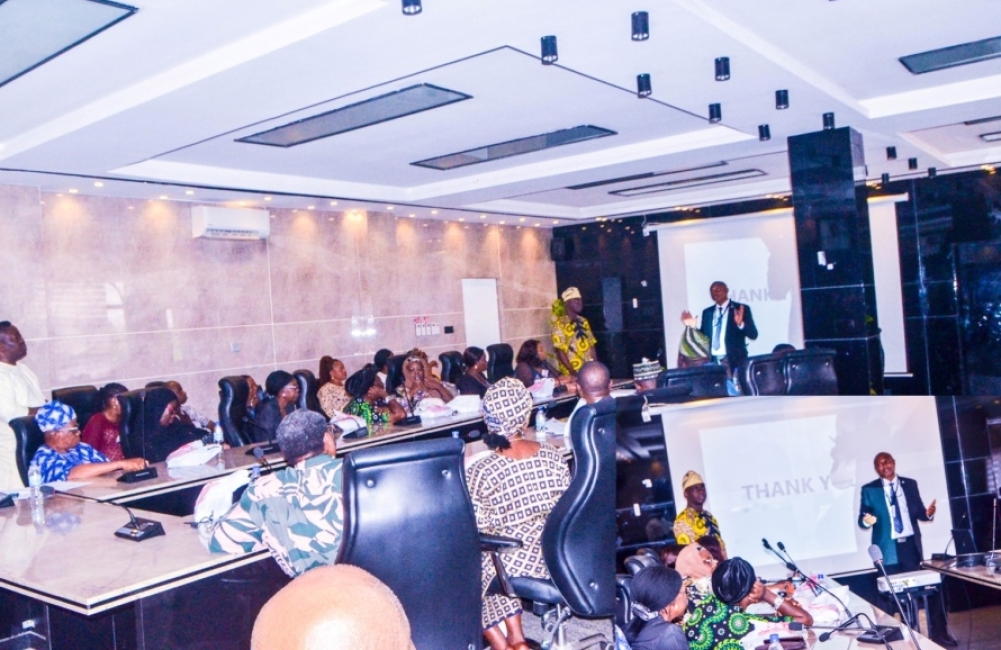
FCSSIP 25: HOUSING MINISTRY SENSITISES STAFF ON INNOVATION As part of the ongoing reforms in the Federal Civil Service, the Ministry of Housing and Urban Development has successfully organized a sensitization programme on Innovation Challenge for staff of the Ministry. The training which held at the Ministry’s headquarters in Abuja, was conducted by the department of Reform Coordination and Service Improvement, a department saddled with the responsibility of coordinating Innovative Ideas and competition in the Ministry. The training was in compliance with the provisions of a recent circular from the Head of Service on the creation of Innovation Division in the MDAs. Innovation which is one of the pillars of the Federal Civil Service Strategy and Implementation Plan (FCSSIP 25), is a systematic introduction of new or significantly improved products, services, or processes, crucial for the improvement of efficiency, effectiveness, and citizen satisfaction. In her address, the Director overseeing the department, Philips Ogoniba Ibifuro informed that the aim of the sensitization programme was to prepare members of staff on how to strategize for emerging innovation technologies, and encourage participation in the upcoming innovation challenge, with an objective to identify innovative high fliers for proper engagement in the Service, as well as ensure full usage and commendations for all adopted innovative initiatives in the MDAs. She stated that the Department has always been in the forefront of driving Government reform initiatives and therefore takes inventions, new ideas and innovations seriously because of its ability to enhance efficient delivery of the mandate of the Ministry. The Director said that the Housing Ministry and its Agencies as a specialized Sector, yearly discover creative works and ideas, which sadly doesn’t receive deserved attention due to stereotypes and bureaucracy bottlenecks, hence the need for the sensitization program. She also recognized the effort of a member of staff who developed an electronic Certificate of Occupancy (e-C of O), adding that it was a tip of the creative mind sets that abound at the Ministry and are yet to be discovered. The program featured a presentation of an overview of the Federal Civil Service Strategy and Implementation Plan (FCSSIP 25) delivered by Henry Nwaedo, from the Office of the Head of Civil Service, and a lecture on ‘Strategies for Emerging Technologies with a Focus on FCSSIP25’, presented by Ojiyovwi Michael, an innovation consultant. Some proposed innovations for the Ministry emanated from the lectures includes; Capacity Building on emerging technologies such as Artificial Intelligence (AI) and cybersecurity awareness, Development Project Management (DPM) methodologies and Facility usage and management. Others are: Process and Service Delivery Re-engineering and Stakeholder Engagements on the use of technologies for citizen feedback on housing policies, as well the establishment of a contact centre with connectivity to critical departments for real time information dissemination and internal communication. In her closing remarks, the Assistant Director of the department Zainab Idris, expressed appreciation to the staff of the Ministry for gracing the sensitization program with their presence. While noting that the resource persons had shared adequate knowledge about innovation, expressing the hope that interested members of staff would participate in the upcoming innovation challenge for the betterment of the Ministry, as well as effective service delivery. ...
Remarks By Babatunde Raji Fashola, SAN At The Inauguration Of The Governing Boards Of The Federal Housing Authority And The Federal Mortgage Bank Of Nigeria
Ladies and Gentlemen,
We gather today to perform a formality. We gather to inaugurate the Governing Boards of the Federal Housing Authority (FHA) and the Federal Mortgage Bank of Nigeria (FMBN) as required by their enabling statutes and as approved by the President, Muhammadu Buhari, GCFR.
As simple and formal as this event is, it has profound consequences.
One consequence is that it offers opportunity to the Nigerians who we inaugurate today to participate in the decision-making process that affect the lives of millions of people, who will partake and benefit of the prosperity that a Housing economy offers.
It is an opportunity whose importance is not to be viewed lightly. This is the opportunity to participate by rendering service, and it is the hallmark of liberal democracy.
Every so often, many of us complain that things are not heading in the direction we like, but how many of us volunteer our time, our skills and our resources to affecting the course of events?
More importantly, how many of us accept to serve with titles that are not headline grabbing like President, Governor, Senator, and Local Government Chairman; and how many will accept to serve without a title?
I have said before that you do not need a title to serve, and if we all pause to look beyond in elective offices, and the big titles, we will see an enormous field of opportunities for service beckoning on men and women of goodwill to step forward and contribute to nation building.
This is the profound decision all of you have taken by accepting these appointments to serve in these two important institutions.
On behalf of President Buhari, the Government and People of Nigeria, I thank you for accepting and for the service you will render to our people.
As to what your roles will be, please let me implore you to quickly avail yourselves of a copy of the respective laws setting up your agencies, where your functions and powers are spelt out.
But if a guide is required, let me say that you will individually and collectively be the conscience of these agencies for implementing the policies of Government, with respect to public housing and mortgage financing in Nigeria.
Some of the programmes and projects of these Agencies will come to you for approvals, and it will be your duty to decide whether to approve or not.
In doing so, you will have to decide whether the proposals are consistent with Law, whether they advance public good, whether they will bring the greatest good to the greatest number of people.
As you undertake this responsibility, please permit me to remind you that it is men and women who build institutions and not the other way around.
Therefore, good institutions are the aggregate of good deeds of good men and women, while unsalutary institutions similarly represent the aggregate of the unsalutary deeds of men and women who, perhaps, were never worthy of the responsibility they were entrusted with.
Ladies and Gentlemen, since the FHA and FMBN were set up, they have experienced their fair share of challenges, while they have also become well-known brands within the country.
This is now your responsibility to reposition these brands and utilize them, by providing the guidance for the Managing Directors and Management teams of FHA and FMBN to enable them deliver service to Nigerians.
For the avoidance of doubt, let me state that the Policy of Government is to deliver Affordable Housing, acceptable to Nigerians and these agencies, whose brands you will now administer are the implementing arms of Government for: a) Housing delivery (FHA) and b) Housing Financing (FMBN).
The Managing Directors and their Management teams have the executive responsibility for carrying these out, subject to your Board oversight, approvals and advice, while the Ministry plays a supervisory role.
Therefore, we expect to see harmony, respect, teamwork and a healthy working co-operation between Board and Management.
On the part of the Ministry, I assure you that we will supervise but we will not interfere.
For your information, we are piloting a Housing Programme and currently constructing in 33 (Thirty-Three) States of Nigeria.
We do this to validate and test what type of housing design responds to Nigeria’s diverse cultural, climatic and religious needs, so as to ascertain what is acceptable and affordable.
We are at different stages of construction in different states, and we have commended these designs to FHA, without imposing them.
Our decision is informed by the evidence of previous housing initiatives that people did not take up and empty houses that still abound in almost every state of Nigeria.
These untaken houses, and the deficit of Housing, suggests to us that the untaken houses are either unacceptable or unaffordable or both.
We see housing as a product, and we take the view that before they can be delivered to market, we must know what the people want and what they can afford.
When our pilot is fully completed, these answers will become self-evident and this is when we can mass produce.
There is certainly nothing that stops FHA from undertaking other designs of housing if she can find a market for it, and she can deploy the income to cross-subsidize and make mass housing more affordable.
As for the financing side, this is critical to affordability and it is as much the function of FHA in cost management and delivery as it is that of FMBN in delivering mortgages of affordable tenures and costs. Since May 2015 to date FMBN has issued 2,724 mortgages worth N20.237BN to assist Nigerians buy their own homes; under the National Housing Fund.
Ladies and Gentlemen, once again, let me thank you for accepting to serve. The tenure and condition of service are contained in the letters of appointment that have been issued to you.
It is my honour and pleasure on behalf of Mr. President and the Federal Government of Nigeria to Inaugurate the Boards of the FMBN and FHA.
Please accept my best wishes for a successful tenure of service.
Babatunde Raji Fashola, SAN
Honourable Minister of Power, Works and Housing
Remarks By H.E, Babatunde Raji Fashola, San At Meeting With Manufacturers Association Of Nigeria (Man) On Tuesday 13th February 2018
I would like to thank you all for responding to our invitation to discuss the possibility of increasing not only access to power for business, but also improving the quantity and quality of power.
For too long, the story of our manufacturing and production sector has been characterized by lack of infrastructure, including power supply, and the best we seem to have done is to talk about the problem and imagine the possibilities if the problems were removed.
Our meeting is important because we gather not to talk about the problem, we gather to solve the problem. As I said at a different forum, we have a new problem; we have more power than we can distribute.
In that context, we cannot continue to talk of lack of power; instead, we must talk about how to connect to the available and unsold power, and what it will cost to do so.
I must, therefore, thank Dr. Frank Jacobs of M.A.N for the enthusiasm with which they have embraced the idea to have this meeting.
For the records, and as a matter of fact, Nigeria’s Power Generating Companies are now able to produce 7,000 MW and the transmission company is able to transport all of it and is expanding its capacity daily.
The distribution companies have also increased their load taking capacity to 5,0000MW.
However, this leaves a gap of 2,000MW of what you manufacturers will call unsold inventory.
This is in the face of more power plants that will come to operation in 2018 as promised by His Excellency, President Muhammadu Buhari, in his New Year Day address, such as Azura, 459 MW; Afam III, 240 MW, Kaduna, 215 MW, and a host of others.
This unsold and increasing inventory is what this meeting offers to manufacturers as your critical Raw Material to reduce the cost of production.
This is why we declared the Eligible Customer Policy and NERC made the rules that guide its implementation, such that bulk power consumers purchase power from GENCOs directly, while ensuring that the business of DISCOs is protected.
For clarity, let me state that under the EPSRA of 2005, the clear intention was that Generation Companies should be able to sell power to 3 (three) classes of persons:
A. The bulk trader (NBET)
B. The Distribution Companies
C. The eligible customer
What we have largely seen are sale to the Bulk Trader.
What we gather to do today is to open the window for sales to the Eligible Customer.
There can be no better time to explore this option than when there is the inventory of unsold power, with the clear promise of more to come.
The market must open to all willing buyers.
This access to power, for manufacturing and production, is the big bridge towards diversification of the Economy.
This is what Nigeria has wanted to do since the 1970s with initiatives such as Operation Feed the Nation and Green Revolution.
But, every time we have started, we have failed to complete the cycle, either due to lack of infrastructure like power to support industries or the elixir of cheap petro-dollars that dim our focus.
Now that Agriculture is back on the right track, Mining is raring to go into industrial production, road and rail infrastructure are being constructed, the Power infrastructure must lock into the mix.
In spite of the spike in oil prices, we must complete this foundation for our Economic and Industrial liberation, by remaining focused. This is what the Buhari Administration seeks to achieve with the Economic Recovery and Growth Plan.
This is the big boost for “Made in Nigeria.”
As you gather today with our technical team, I urge you to be open, frank and, most importantly, be flexible. The negotiations may be tough, but please never walk away from the table.
See only one reason why we must try this, and ignore all the naysayers, who only see why new things should never be done.
Every one of you here today stands at the cusp of history as you deliberate on the necessary actions to build the Bridge that Connects Nigeria’s Industrial Backbone to Electricity.
I await the outcome of this meeting expectantly, and I wish you fruitful deliberations.
Thank you very much.
Babatunde Raji Fashola, SAN
Honourable Minister of Power, Works and Housing
Tuesday 13th February 2018

Housing Ministry, Shelter Advisory Convene Summit on Renewed Hope Housing PPP
FMHUD 2025 STAFF AWARDS & RECOGNITION CEREMONY, MONDAY, MARCH 30, 2026
FMHUD 2025 STAFF AWARDS & RECOGNITION CEREMONY, Monday, March 30, 2026
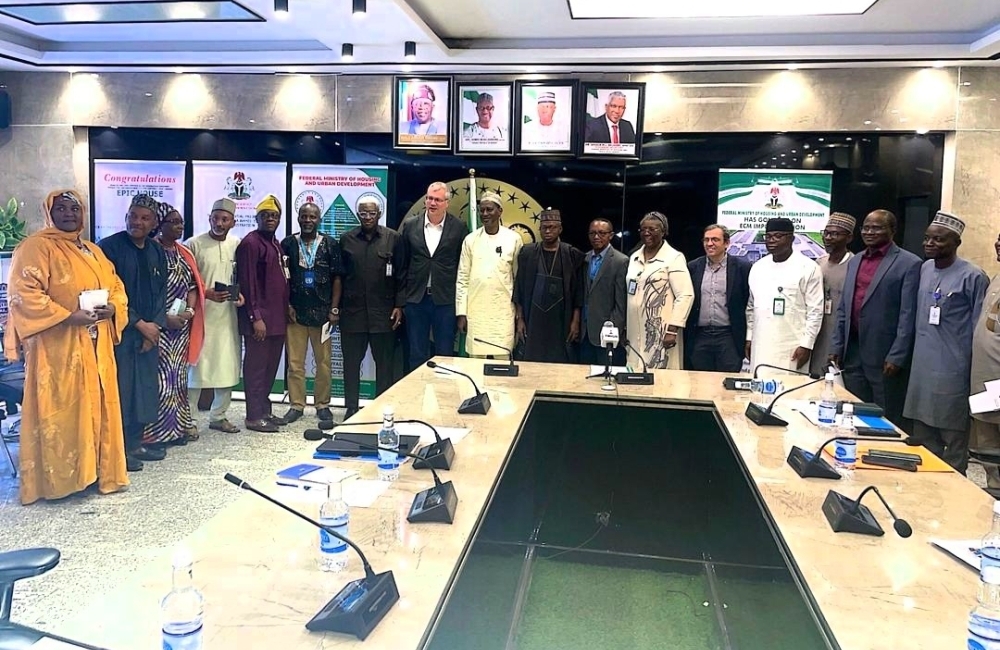
MEETING OF THE HON MINISTER, FMHUD AND HEAD OF UN HABITAT, WEST AFRICA HUB, DAKAR, MR MATHIAS, SPALIVIERO, WEDNESDAY, 25TH FEBRUARY, 2025
Meeting of the Hon Minister, FMHUD and Head of UN Habitat, West Africa Hub, Dakar, Mr Mathias, Spaliviero, Wednesday, 25th February, 2025